
Understanding Copper Procurement Differences-copper concentrates sourcing
Explore the key distinctions in copper procurement, focusing on copper suppliers, copper concentrates sourcing, and long-term copper offtake agreements. Make informed decisions and optimize costs for reliable production supply.
By ZTRone Resources team
4/3/20262 min read
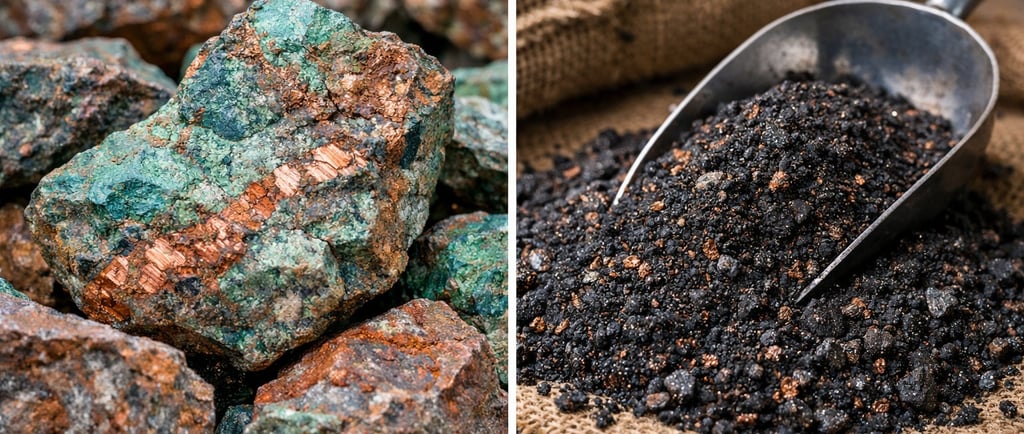
Copper Ore vs Copper Concentrates: A Complete Guide for Chinese Buyers Seeking Reliable Supply
Introduction: Understanding the Difference in Copper Procurement
As China remains the world’s largest consumer of copper, industrial buyers, smelters, and trading companies continuously search for reliable copper suppliers, copper concentrates sourcing, and long-term copper offtake agreements.
One of the most common areas of confusion in global procurement is the distinction between copper ore and copper concentrates. Understanding this difference is essential for making informed purchasing decisions, optimizing costs, and ensuring consistent production supply.
What is Copper Ore? (Raw Copper Material)
Copper ore is the unprocessed material extracted directly from mines, containing copper mixed with other minerals such as iron, sulfur, and silica.
Key Features of Copper Ore:
Low copper content (0.5% – 2% Cu)
High impurity levels
Requires beneficiation before use
Not suitable for direct industrial processing
Important for Chinese Buyers:
Most large-scale Chinese smelters and manufacturers do not import raw copper ore due to:
High logistics cost
Low metal recovery efficiency
Inconsistent quality
What are Copper Concentrates? (Preferred Industrial Feedstock)
Copper concentrates are produced by processing copper ore through crushing and flotation, resulting in a high-grade material used directly in smelting.
Key Features of Copper Concentrates:
Copper content: 20% – 30% Cu
Reduced impurities
Powdered or granular form
Ready for smelting and refining
Why Chinese Buyers Prefer Copper Concentrates:
Lower transportation cost per unit of copper
Standardized quality (SGS/Intertek assay reports)
Compatible with smelter requirements
Easier contract structuring (LME pricing)
Copper Ore vs Copper Concentrates: Key Differences
Factor
Copper Ore
Copper Concentrates
Copper Content
0.5% – 2%
20% – 30%
Processing Level
Raw
Processed
Industrial Use
Limited
Smelting feedstock
Logistics Efficiency
Low
High
Market Demand
Low
Very High
Pricing
Non-standard
LME-based
Copper Supply Chain: From Mine to China
The global copper supply chain follows this structure:
Mining of copper ore
Processing into concentrates
Export to major markets (China, Europe, Asia)
Smelting into copper cathodes
China imports millions of tons of copper concentrates annually, primarily from:
Africa (DRC, Zambia)
South America (Chile, Peru)
Central Asia
Pricing Structure: What Chinese Buyers Must Know
Copper Concentrates Pricing Formula:
Based on London Metal Exchange (LME) copper price
Adjusted with:
Treatment Charges (TC)
Refining Charges (RC)
Penalties for impurities
Example:
LME Price – (TC/RC + penalties) = Final purchase price
Key Requirements for Serious Buyers
To successfully procure copper concentrates, Chinese buyers must prepare:
1. Letter of Intent (LOI)
Defines quantity, contract duration, and delivery terms
2. Proof of Funds (POF) / Bank Comfort Letter (BCL)
Demonstrates financial capability
3. Assay Verification
SGS or Intertek certification
4. Logistics Capability
CIF or FOB contract readiness
Port handling capacity
Common Mistakes to Avoid
Buying copper ore without processing capacity
Ignoring impurity penalties (arsenic, sulfur)
Working with unverified suppliers
Entering contracts without clear LME linkage
Conclusion: Why Copper Concentrates Are the Right Choice
For Chinese smelters and industrial buyers, copper concentrates—not raw ore—represent the true global trading standard.
They offer:
Higher efficiency
Lower cost per unit
Better contract structure
Reliable long-term supply
Understanding this distinction allows buyers to reduce risk, improve margins, and secure sustainable copper supply chains.
By ZTRone Resources Team.